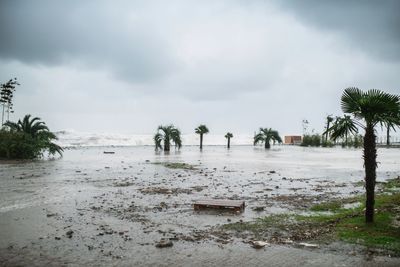
The Price of Flooding
Who Pays for Florida’s Growing Flood Mitigation Bill?
A Price of Sprawl Institute Study
Florida's flood problem is no longer limited to its coastline.
As development spreads into rural and inland areas, natural landscapes that once absorbed and slowed stormwater are increasingly being replaced by roads, rooftops, parking lots and other impervious surfaces. Wetlands, floodplains and natural depressions that once provided valuable flood-storage capacity are also being altered or lost.
The result is a growing public bill for drainage improvements, stormwater systems, flood mitigation, road repairs, emergency response and infrastructure replacement.
The fundamental question is:
Who ultimately pays for the cost of managing the additional water created by Florida's continued development?
Increasingly, the answer is taxpayers, local governments and homeowners.
Florida's Flood Risk Is Not Limited to Mapped Flood Zones
Flood maps do not eliminate flood risk.
FEMA has long emphasized that flooding can occur outside federally designated high-risk flood areas. A commonly cited FEMA estimate is that approximately one-quarter of flood claims occur outside the high-risk areas shown on traditional flood maps.
This is particularly important in Florida, where intense rainfall can overwhelm drainage systems far from the coast.
Citizens Property Insurance Corporation is responding to this broader risk. Florida law has phased in a requirement that Citizens policyholders with personal residential policies and wind coverage obtain separate flood insurance. Beginning January 1, 2027, the requirement generally applies to all such residential properties regardless of whether they are located in a FEMA Special Flood Hazard Area, subject to statutory exceptions. [1]
That policy change is significant.
It represents an acknowledgement that flood risk does not stop at the line on a FEMA map.
For inland homeowners, however, purchasing flood insurance is only one part of the cost. Communities must also pay to prevent or reduce the flooding in the first place.
The Natural Infrastructure Florida Is Losing
Florida's wetlands are not simply environmentally sensitive lands. They are part of the state's natural flood-control system.
The Florida Department of Environmental Protection states that wetlands provide flood storage during heavy rainfall, allowing water to spread across undeveloped areas without damaging developed uplands. DEP also specifically warns that filling wetlands can increase both on-site and off-site flooding. [2]
Florida has lost more than 9 million acres of natural wetlands over approximately the past 200 years, according to DEP. Much of that loss resulted from drainage and filling. [3]
Development also changes how water moves across an entire watershed.
According to DEP, urbanization:
- compacts soils;
- adds impervious surfaces;
- alters natural depressions, floodplains and wetlands;
- increases the efficiency of drainage systems; and
- increases the volume and speed of stormwater runoff.
DEP notes that these changes can contribute to flooding, water-quality problems and habitat loss. [4]
This creates an important fiscal issue.
When natural systems are removed, governments must increasingly replace those functions with engineered infrastructure.
Instead of allowing wetlands, floodplains and natural drainage systems to store and slowly release water, taxpayers may have to finance:
- stormwater ponds;
- drainage pipes;
- enlarged culverts;
- pump stations;
- canals and conveyance systems;
- detention and retention facilities;
- flood-control structures;
- road elevation;
- bridge improvements;
- floodproofing of public buildings;
- drainage easements; and
- acquisition or restoration of flood-prone properties.
Natural infrastructure is being replaced with infrastructure that must be designed, built, operated, repaired and eventually replaced.
That is the Price of Flooding.
The Cost Can Range from Hundreds of Thousands to Tens of Millions
Flood mitigation does not have a single price tag.
A relatively small drainage project can cost several hundred thousand dollars, while a major watershed or municipal drainage project can cost tens of millions.
For example, the City of Bradenton lists a $300,000 drainage improvement project involving storm pipe and inlet construction intended to reduce flooding. [5]
At the other end of the spectrum, Seminole County's Midway Drainage Improvement Project represents more than $30 million in proposed improvements. The project includes stormwater pipes, inlets, ponds, roadside swales and other drainage improvements designed to address longstanding flooding problems. [6]
Another example demonstrates how quickly costs escalate when a drainage problem affects an entire watershed. A Southwest Florida Water Management District project in Hillsborough County estimated approximately $45.75 million for eventual design, permitting and construction of a drainage conveyance system serving an approximately 2,110-acre urbanized basin. [7]
These are not isolated examples of government spending.
They illustrate the scale of the infrastructure necessary to compensate for inadequate drainage capacity, aging infrastructure, changing rainfall patterns and development that has altered the natural movement of water.
The Resilient Florida Funding Gap
Florida created the Resilient Florida Program to help communities address flooding and other climate-related vulnerabilities.
The program is important because many local governments cannot afford major resilience projects using local revenues alone.
However, recent research by WUFT raises a significant concern about how those resources are distributed.
WUFT analyzed more than 1,200 applications submitted during the program's most recent four application cycles and found a substantial difference between coastal and inland communities.
Since the program began in 2021, Resilient Florida has awarded implementation grants to 347 projects in coastal counties compared with only 30 in inland counties.
Coastal communities have received more than $1.6 billion toward project costs—nearly 20 times the amount received by inland counties.
WUFT found that approximately 92 percent of shovel-ready projects funded since the program's launch have been concentrated in coastal counties, with Miami-Dade, Broward and Palm Beach counties alone accounting for 52 percent.
The disparity is not explained entirely by the number of applications.
According to WUFT's analysis, approximately 27 percent of coastal infrastructure projects submitted during the four most recent application cycles received funding compared with approximately 16 percent of inland projects. [8]
This creates an important public-policy question:
If flooding is a statewide problem, should resilience funding be concentrated primarily where flooding is associated with the coast?
Coastal Florida unquestionably faces enormous flood risks. Hurricanes, storm surge and sea-level rise create extraordinary infrastructure challenges.
But inland Florida faces a different—and increasingly expensive—set of problems.
Inland Florida Cannot Simply Be Treated as Someone Else's Problem
Inland counties may not have seawalls, beaches or tidal flooding, but they have watersheds.
Water that falls in one location does not necessarily remain there.
It moves through:
- wetlands;
- creeks;
- drainage ditches;
- lakes;
- floodplains;
- agricultural lands;
- residential developments; and
- municipal drainage systems.
When development changes one portion of a watershed, the consequences can extend beyond the property where construction occurred.
This is particularly important when wetlands and natural storage areas are removed or altered.
DEP explicitly recognizes that wetland filling can increase off-site flooding. Urban development can also increase the volume and speed of stormwater runoff. [2][4]
Therefore, a development project may produce costs that are not reflected in the price of the house or the development itself.
The developer receives the economic benefit of additional development.
The homeowner purchases the house.
But the county may eventually have to enlarge the drainage system.
And taxpayers may have to pay for it.
The Hidden Cost of Development
Traditional development economics often focuses on the immediate costs and benefits of construction:
Land + Construction + Infrastructure = Development
But that formula can leave out long-term public costs.
A more complete calculation is:
Development Cost + Infrastructure Cost + Long-Term Public Cost = True Cost of Development
Long-term public costs can include:
- flood mitigation;
- stormwater maintenance;
- road repairs;
- bridge replacement;
- emergency response;
- damaged public facilities;
- drainage maintenance;
- watershed restoration;
- property acquisition;
- insurance losses;
- disaster recovery; and
- future infrastructure expansion.
These costs can appear years after a development project has been approved.
That makes them easy to overlook during the original rezoning, comprehensive-plan amendment or development approval.
The Fiscal Problem With Upzoning
The Price of Sprawl Institute has previously examined how comprehensive-plan amendments and upzoning can make fiscal planning more difficult for local governments.
Flood mitigation is one of the clearest examples.
A parcel may be approved for significantly more intense development than originally contemplated.
That can mean:
- more homes;
- more rooftops;
- more roads;
- more parking;
- more impervious surface;
- more stormwater runoff; and
- more pressure on downstream drainage systems.
Even when a development's individual stormwater system satisfies permitting requirements, the broader watershed may still experience cumulative impacts.
A county may therefore approve hundreds or thousands of additional homes without having a precise understanding of the future public cost of managing the additional water generated throughout the watershed.
The problem becomes particularly difficult when several jurisdictions are developing within the same watershed.
One county's development may affect another county.
One city's drainage system may discharge into another jurisdiction.
And downstream taxpayers may ultimately help pay for upstream development.
Resilient Florida Shows Both the Need and the Cost
The Resilient Florida Program itself demonstrates how expensive flood mitigation has become.
The state's grant program requires applicants to demonstrate the cost-effectiveness of proposed projects, including comparisons between project costs and avoided economic losses from flooding, erosion and other foreseeable damages.
DEP's own guidance recognizes that resilience projects must be evaluated by comparing the cost of mitigation with the cost of future damage. [9]
That is an important principle.
But it also raises a larger question:
Why should taxpayers continually pay to retrofit communities after development has changed the natural drainage characteristics of an area?
If a community must spend $30 million to correct a drainage problem, that cost is real regardless of whether the money comes from:
- county taxes;
- municipal taxes;
- stormwater fees;
- state grants;
- federal grants;
- special assessments; or
- another government program.
Government grants do not make the cost disappear.
They simply determine which taxpayers pay the bill.
Federal, State and Local Funding Are Still Taxpayer Dollars
Flood mitigation projects are frequently assembled from multiple funding sources.
A local project might receive:
- 25 percent from a city;
- 25 percent from a state program; and
- 50 percent from FEMA or another federal program.
It may appear that the local government has avoided most of the cost.
But the cost has not disappeared.
It has simply been distributed among different levels of government.
The federal share is ultimately supported by federal taxpayers.
The state share is supported by Florida taxpayers.
The local share is paid by local taxpayers.
And when local governments must provide matching funds, residents may see the cost through property taxes, sales taxes, stormwater fees, utility charges or other local revenues.
There is no such thing as free flood mitigation.
There are only different ways of allocating the bill.
The Insurance Cost Is Another Bill
Flood mitigation is also becoming an insurance issue.
Citizens' phased-in flood-insurance requirement illustrates the financial consequences of Florida's growing exposure to flooding.
By 2027, eligible Citizens residential policyholders generally will be required to maintain flood insurance regardless of whether the property is located inside a FEMA Special Flood Hazard Area. [1]
That means a homeowner outside a traditional flood zone may face an additional insurance expense.
The reason is straightforward: flood risk exists outside the mapped zones.
The financial implications are significant because insurance is only one layer of the cost.
A homeowner may pay for:
- flood insurance;
- homeowners insurance;
- local stormwater fees;
- property taxes used for infrastructure;
- special assessments;
- disaster-related taxes or assessments; and
- the cost of repairing uninsured or underinsured damage.
The same homeowner may also be paying taxes to finance the public infrastructure designed to reduce the probability of that flooding occurring.
The Price of Losing Natural Flood Protection
There is an economic value to wetlands and other natural systems even when they do not generate traditional tax revenue.
A wetland does not send the county a property-tax check.
But it can store water.
It can slow runoff.
It can reduce downstream flooding.
It can help recharge groundwater.
And it can provide ecological services that would otherwise require engineered infrastructure.
When that natural capacity is removed, the public may have to replace it.
That replacement has a price.
The choice facing Florida is therefore not simply:
Development or no development.
The more important question is:
Who pays for the consequences of development?
If new development increases the demand for public drainage infrastructure, the cost should not automatically be shifted to existing taxpayers.
Growth Should Pay for Growth
Florida needs a more complete approach to growth and flood mitigation.
Before approving significant increases in development intensity, local governments should be able to answer basic fiscal questions:
1. How much additional stormwater will the development generate?
2. Where will that water go?
3. Does the existing watershed have adequate capacity?
4. What wetlands, floodplains or natural storage areas will be affected?
5. What downstream communities could be affected?
6. What infrastructure will eventually be required?
7. What will that infrastructure cost to construct?
8. Who will pay for construction?
9. Who will pay for maintenance?
10. Will existing taxpayers be responsible for future improvements?
These questions should be answered before development is approved—not after residents begin experiencing repeated flooding.
A Better Flood Mitigation Strategy
Florida's flood strategy should not simply be about building more drainage infrastructure after problems occur.
It should also be about preventing unnecessary increases in stormwater runoff.
That means considering:
Protecting wetlands
Natural flood-storage areas should be treated as part of Florida's infrastructure system.
Protecting floodplains
Floodplains provide natural storage capacity that becomes increasingly valuable as development intensifies.
Preserving watershed function
Flood mitigation should be evaluated at the watershed level rather than only at the individual development site.
Requiring growth to pay its proportional infrastructure cost
Existing residents should not automatically subsidize infrastructure created by new development.
Improving inland access to resilience funding
The Resilient Florida Program should recognize that inland flooding can create major public costs even when a community faces no coastal storm surge.
Improving cumulative-impact analysis
The question should not simply be whether one project can manage its own stormwater. The question should also be whether hundreds of projects collectively change the hydrology of an entire watershed.
The Price of Sprawl Is More Than Roads
The traditional discussion about sprawl often focuses on roads, schools and utilities.
Flooding should be added to that list.
Every new subdivision, shopping center, warehouse and roadway changes how water moves across the landscape.
The costs may not appear on the developer's balance sheet.
They may not appear when the zoning change is approved.
And they may not appear when the first house is sold.
But years later, the bill can arrive in the form of a $300,000 drainage project, a $3 million stormwater improvement, or a $30 million watershed overhaul.
Then the public is asked to pay.
That is the Price of Sprawl.
Conclusion
Florida cannot continue treating flood mitigation as an unlimited public expense that follows development.
The state is already spending billions of dollars to protect communities from flooding. Local governments are spending millions more. Homeowners are being required to purchase flood insurance even when their properties are outside traditional flood zones.
At the same time, Florida continues to experience rapid population growth and development pressure.
The policy question is not whether Florida should grow.
Florida will grow.
The question is whether growth will be financially responsible.
When wetlands are filled, natural drainage is altered and development expands across watersheds, the resulting costs do not disappear.
They are transferred.
Transferred to county governments.
Transferred to cities.
Transferred to state and federal taxpayers.
Transferred to insurance policyholders.
And ultimately transferred to Florida homeowners.
Growth should pay for growth.
Florida should not wait until neighborhoods flood to discover that the infrastructure necessary to support development was never properly accounted for.
The true cost of development must include the cost of managing the water that development creates.
Because when natural flood protection is replaced with concrete, pipes and pumps, somebody has to pay for it.
And increasingly, that somebody is the taxpayer.